

Many great ideas begin with a single breakthrough—a "moment zero." Coffideas was born differently. It wasn't a bolt of lightning from the sky, but the sum of hundreds of meetings, observations, and conversations. It was a process—like solving a multi-sided puzzle where the meaning only emerges once you begin connecting elements from seemingly distant worlds.
At Coffideas, we've been mixing these worlds from the start: business, sports, music, and education. Though they may not share a label, they share a common thread: people attend events because they want something more than dry information or hollow small talk. They are looking for energy, inspiration, and connection. Often, the most important "shift" didn't happen during the main presentation, but in the spaces between—in the hallway, over coffee, in a brief conversation that suddenly became more vital than the entire agenda.
The Engineering conclusion
There was, however, a point where our collective experiences gained a clear direction. A single, engineering conclusion emerged: the ability to listen and converse is the foundation. Without it, there is no community, no collaboration, and no true growth.
This realization matured everywhere—from corporate boardrooms to environments where trust is the only currency. At some point, we understood that conversation had stopped being a "nice addition" to events. It had become the very reason people left their homes in the first place. Thus, Coffideas was born—not as another format, but as relationship engineering that gives people back their greatest superpower: time for a conversation with sense.
The Flat White Economy
Standing in the background of the Coffideas story is the Flat White Economy. This phenomenon makes it clear: the world's progress doesn't happen in spreadsheets, but in meeting spaces. Coffee is just a symbol—a ritual that creates the context for an exchange of thoughts. In a rushed world, meeting places are catalysts for social energy, but for that energy not to evaporate, it needs a framework.
We realized that conversation cannot be left to chance or mere improvisation. It must be a format—a repeatable method that works in any organizational culture, at any event. Thus, the bedrock of Coffideas was born: 15 minutes.
Why 15 minutes?
This number is pure pragmatism. 15 minutes isn't meant to "finish the topic" from A to Z. It is meant to trigger something. It is an impulse. A person leaves with one new perspective, one sentence that sticks. The implementation of change doesn't happen at the table—it happens later, in life and at work, because those 15 minutes often shift one's outlook or broaden their perspective.
Coffideas is the answer to the paradox of our times. We all crave connection, but the world pushes us into transactional "task mode" without contact—into priorities and notifications. Conferences and workshops are meant to unite us, but we often don't know how to do it in practice. Our method lifts that weight off the participants' shoulders. We provide a structure that turns a "nice-to-have" into a generative dialogue.
It is a methodology for restoring people's greatest superpower in a world that constantly tries to distract them.
Designing for everyone: introverts, extroverts, and tech
We go to events for knowledge, but we stay for the people. We want to feel that our experience is valuable to someone else and that we aren't alone in our challenges. This is where Coffideas fulfills its mission, reconciling two seemingly distant worlds:
- For the introvert: Traditional networking is a high-cost energy drain.
- For the extrovert: It's an easy start that often gets bogged down in superficial small talk.
The method takes the burden of "networking skills" off both groups. Coffideas provides a framework that guarantees safety for the introvert and provides depth and meaning for the extrovert. Participants don't have to sell anything or play a role—their task is simply to be in the conversation for 15 minutes.
In this method, we reverse the role of technology. The phone, which usually distracts us, becomes a tool for supporting real-life encounters. The app guides you so you can focus entirely on the person in front of you.
This breaks the "conference static." The mechanism of matching in groups of four turns screens into game elements. People find each other in the crowd, hold up their phones, sometimes even stand on chairs to find their group. It's the moment technology stops pulling us away from humans and starts generating the movement, lightness, and energy we so desperately need.
The 15-minute rhythm
The most important part of Coffideas isn't how people find each other, but what happens within those fifteen minutes. This time is a precisely designed rhythm:
-
Defining the topic: We start by clarifying the subject. "Problem with the boss" is just a slogan; "my boss doesn't read my emails" is a concrete starting point. This is the first breakthrough.
-
Generative dialogue: For eleven minutes, the group doesn't just discuss; they generate a new quality—colliding perspectives the participant wouldn't find in their own bubble.
-
Takeaways: At the end, everyone shares what they are taking with them. This closes the process and ensures the conversation leaves a lasting mark in the mind.
This structure didn't emerge overnight; it was refined through countless iterations, constantly testing and challenging our assumptions.
The Ultimate lesson: Helping is learning
The greatest lesson we learned from Coffideas completely overturned our initial assumptions. We intuitively thought success would be defined as "I got an answer to my problem." In practice, it was something else entirely.
[qoute red] The greatest satisfaction comes from helping. [/quote]
8 out of 10 people leave a session feeling happy not because they received something, but because their experience was needed by someone else. Coffideas reminds us of a fundamental truth we often forget in "task mode": the greatest value comes from what we can give to another human being. This is the superpower of conversation that we unlock at every table.
Looking ahead: The network effect
The method grew naturally. Hundreds of conversations, thousands of participants, dozens of organizations. It quickly became clear that Coffideas is much more than "cool networking." Over the years, it has become a tool supporting diversity, inclusion, and relationship building in remote or dispersed structures.
In a world where the "S" in ESG (Environmental, Social, and Governance) is often reduced to dry demographic statistics, we show a deeper dimension: the network effect. We show how people truly connect, how collaboration is born, and where the heart of an organization beats.
We created a methodology where technology is not the goal, but the engineering support for human behavior. Coffideas was never about the app itself. It was about people doing something that is technically simple but practically difficult today: sitting down together and truly talking.
If we were to leave you with one thought that holds this whole story together, it would be this:
6.1. The Coffideas app: State of the art
The Coffideas app was designed according to a principle that is my foundation: technology should support our natural behaviors, not try to change them. A tool only makes sense when it enters our lives organically, becoming a silent accomplice to human mechanisms.
This is why the matching moment in Coffideas turns into a "game"—a black-and-white form gives way to a colored icon that allows people to instantly find each other in a crowd. It's a seemingly simple move, but in practice, it's pure Experience Engineering: we turn conference chaos into rhythm and lightness.
Through years of iteration, we have brought this solution to a State of the Art level. If you are building your own products or evaluating the tools you use, these two pillars of our UI/UX philosophy may serve as key inspiration for you:
Radical minimization: less means "I Can"
Most applications make the mistake of "over-abundance," believing that the user will choose what they need. In a situation of stress, noise, and the intensity of an event, people don't choose—they get lost.
- Our approach: The Coffideas interface contains exactly what is necessary at that specific split second.
- The effect: A clear information hierarchy lifts the decision-making burden off the user's shoulders. We show only what is important "now." The rest remains hidden so as not to distract attention, which is our most valuable currency.
Technology as support, Not the goal
The app is not the hero of the meeting. The hero is the conversation. Therefore, every solution in the interface serves the goal of having the user... put the phone down and look into the eyes of another person as quickly as possible. Good design is design that becomes invisible the moment the real magic starts happening between people.
Designing from the Perspective of roles
The second pillar of our method is designing from a role-based perspective. At every stage of Coffideas' development, I asked myself the same question: "What does this person see and feel at this specific moment?" This approach allowed us to create an interface that doesn't assume ideal laboratory conditions but works in the real world—a world of event chaos, stress, and unpredictability.
As a Tech-Humanist, I build systems that "carry" the logic of the process for the human, taking the decision-making weight off their shoulders. Here is how it looks in practice:
Design empathy: Closing your eyes
- The participant: Wants to enter the process effortlessly. They don't want to learn an app; they want an experience. The interface must feel like instinct.
- The host/organizer: Has a thousand things on their mind. The system must be a "safe base" for them—informing, calming, and prompting the next step.
The Host panel: State of the Art in combat conditions
This is where you see the difference between a "pretty" app and a "useful" one. The host cockpit in Coffideas is a dashboard that responds in real-time to questions before the host even asks them:
- Attendance status: You see the number of people online and offline. You know exactly if someone just left the room or if a connection was dropped, without guessing or counting heads.
- Topic logistics: The system immediately shows how many accepted topics we have and how many tables we can form from them.
- Dynamics management: If new threads are lacking, the system allows you to restore valuable topics from previous sessions with a single click.
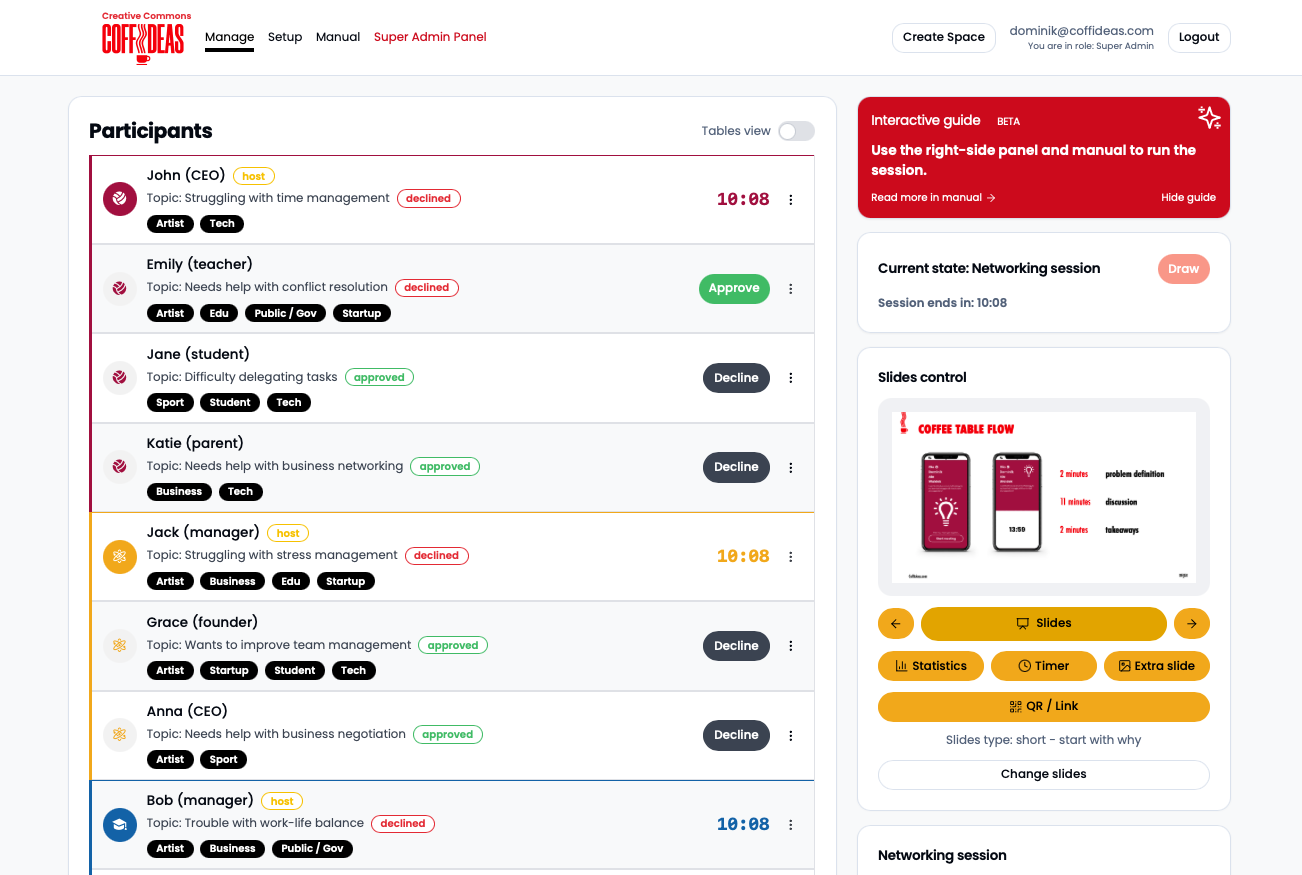
All this critical data is available on a single screen, without the need to click through multiple menus. As a result, the host doesn't have to keep all the event statistics in their head—they can focus on the people and their energy, while the system handles the foundations.
In Coffideas, technology is not "just another task" for the organizer. It is an intelligent assistant that makes leading a complex session as natural and fluid as brewing a good cup of coffee.
The instant live paradigm
Another cornerstone of Coffideas is the Instant Live paradigm. In the world of events, where every second of downtime kills the room's energy, technology must be transparent and immediate. Within our system, everything happens in real-time: participant registration, data editing, or status changes are instantly visible in the host panel. This "instant live" nature provides the facilitator with a rare luxury—a sense of full control over crowd dynamics. You can see where people are stuck and where the process is flowing, allowing you to react before impatience even has a chance to set in.
Resilience engineering: Designing for reality
As an engineer and practitioner, I know that even the most beautiful interface will fail if it isn't prepared for a collision with reality. And event reality can be brutal:
- Crashing Wi-Fi with 300 people trying to connect.
- LTE "dead zones" in concrete office buildings.
- Restrictive security policies on corporate phones.
That is why in Coffideas, we applied Resilience Engineering.
Data diet (Minimal data transfer)
We consciously limited the amount of transferred information to the absolute minimum. The app doesn't "bloat" with unnecessary scripts. This ensures it remains stable even in conditions where other tools would display a connection error. This is our answer to a reality where a stable internet connection is often a luxury.
State persistence
This is a mechanism that is truly appreciated only during a crisis. If a participant's browser crashes, their battery dies, or they momentarily lose signal—the system does not force them to start from scratch. Upon returning, they see exactly where they left off: the same form, the same "waiting for matching" screen, or the same table they were assigned to.
This lifts the frustration off the participant's shoulders and the need for technical support off the host's. Coffideas technology is like good infrastructure: you don't notice it when it works, but you are grateful that it "remembers you" when something goes wrong. We design for failure so the experience remains flawless.
Flow engineering and the smart QR key
What I call Flow Engineering is completed by the QR code scanning mechanism. In Coffideas, a QR code is not just a link to a homepage—it is an intelligent key. If a participant loses their connection and rescans the QR, the system flawlessly recognizes them: "This is you; you are assigned to the Blue Table."
We abandoned traditional registration (login, password, email) because it is a barrier that kills momentum. However, by maintaining state continuity, the participant feels looked after by the system. This is a level of comfort usually reserved for high-end apps, brought into a lightweight, browser-based format that requires no installation.
The interactive manual
Most tools provide instructions as a PDF or a separate help page. That's a design mistake—it forces users to switch context and lose their flow at the exact moment when they're most focused. In Coffideas, the manual is an integral part of the application and works in a truly unique way:
- "Living components" principle: The manual doesn't contain only screenshots and descriptions. It contains live components.
- No context switching: If you're reading about how to change the event language, you'll find the exact same toggle inside the instruction text that exists in the settings. You can click it and change the language… while reading the instructions.
- Contextual agency: If the manual talks about categories, you see an active module for managing them. You read the "what and why," and you do it immediately—in the same place.
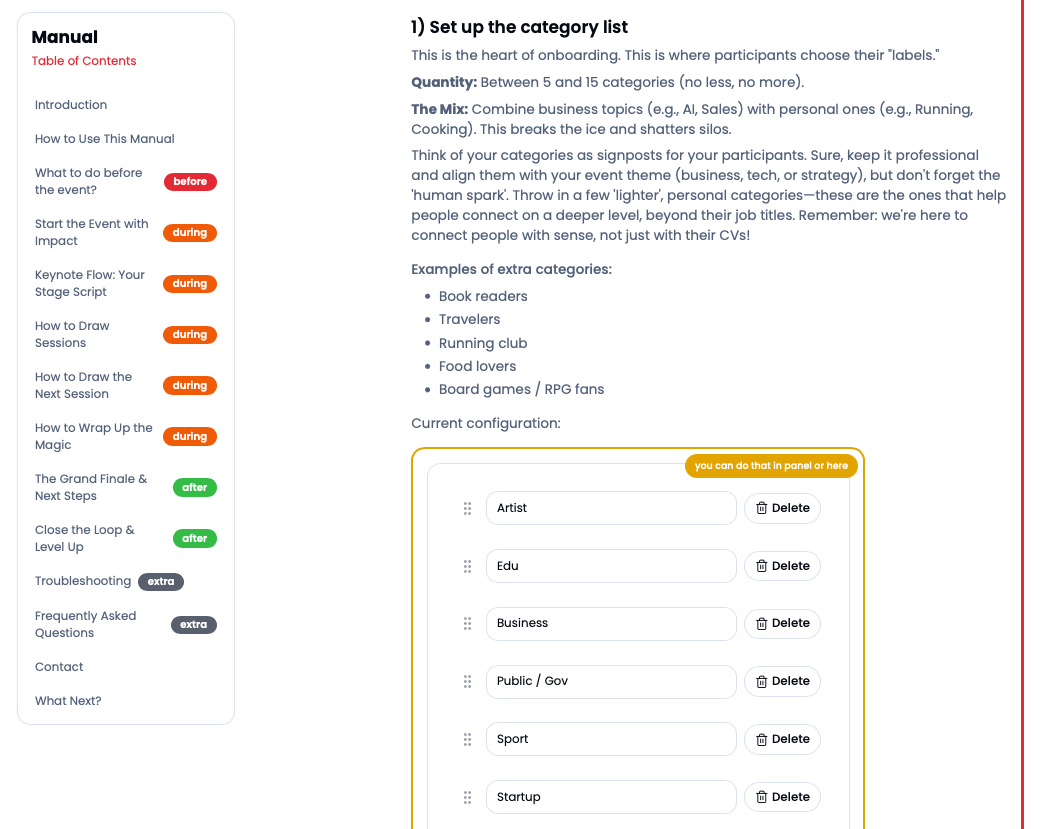
It's a philosophy—and a convenience—where knowledge of the process and the tool for executing it become one. The manual stops being an "instruction booklet" and becomes an active guide that leads the host by the hand through the entire process—from preparation, through the session dynamics, all the way to the wrap-up.
We remove the stress of "learning the system" from the organizer. In Coffideas, the system teaches you through doing—staying consistent and predictable from the very first step to the last.
Coffideas is a process of evolutionary design. The interface reached state of the art status not because it was born from a single sketch, but because it changed from event to event—it was tempered in battle. Every function has passed through the sieve of hundreds of interactions, and what remains is a pure extract of utility.
As a designer, as the person responsible for this area, I made the hardest of decisions: the decision to renounce. In the world of technology, "more" is easier than "less." The art is to say: "We aren't doing this because it is just flashy noise." Because of this, Coffideas does not suffer from an excess of form. It has exactly what is needed—at the right moment and for the right person.
For us, this is the purest definition of good technology:
- It doesn't try to dazzle with its presence.
- It doesn't force the user to admire the interface.
- It simply removes obstacles so people can do what matters most.
In Coffideas, that "something important" is a real conversation. The app is only (and yet) a catalyst. Its purpose is to make contact with another person instinctive, fast, and possible—even when the Wi-Fi fails and the conference hall feels like a labyrinth.
6.2. The pandemic: When "offline only" had to meet reality
The pandemic was a "moment of truth" for Coffideas. It was the point where our fundamental assumption—that we are an exclusively offline tool—collided with the reality of a world that closed itself within four walls overnight.
As a tech-humanist, you face the most difficult dilemma: do you hold orthodoxly to your vision and wait for the world to return to normal, or do you try to transpose the "soul" of the solution to where people need it most, even if the conditions are far from ideal?
Clashing with the dogma: "Only in real life"
From the beginning, Coffideas had a certain physicality. It wasn't just a conversation—it was movement, finding your group, holding up phones, the energy of the room. It was all those "micro-behaviors" that build trust before the first word is even spoken. That is why to every question about an online version, we answered: "no." We were afraid that online, Coffideas would become just another boring Zoom call, where instead of the energy of a meeting, we would have only tiles with faces.
The moment "No" became a challenge
The pandemic didn't just take away our conference rooms; it drastically increased the demand for what Coffideas provides best: a sense of meaning and connection. In a world of isolation, conversation stopped being a "nice addition" and became a scarce commodity, essential for mental and professional survival.
It was then we realized that if our mission is to support conversation, we cannot desert just because the communication channel has changed. The challenge was not "making a video conference"—there were plenty of those. The challenge was: how to transfer trust engineering and group dynamics to a world where you cannot shake hands?
Pragmatic rebellion
The story of the pandemic at Coffideas is a tale of pragmatic rebellion. For the first six months, like most of the world, we waited. We believed that "offline only" was our inviolable dogma. But as reality began to stretch into infinity, we had to adapt. As process engineers, we knew one thing: if we didn't test it in battle, the idea might simply fade away.
We made the decision to build an online prototype. It was a "guerilla" setup—Google Meet, simple links, windows, and microphones. But in this raw environment, we looked for the answer to a fundamental question: is the heart of Coffideas physicality, or is it the structure?
The test results surprised us. It turned out that:
- The 15-minute frame works everywhere—online, it disciplines even more than in a room.
- Generative dialogue is possible through a screen, if people have a clear goal and a safe structure.
- The hunger for meaning online was so massive that Coffideas became an antidote to "Zoom fatigue" for participants. It wasn't just another call—it was a meeting with a human being.
The hardest decision: A conscious return
We had a working online product in our hands. We could have gone for scale, for reach, for the global market that was desperately seeking remote integration tools at the time. We could have become the "Zoom for relationships."
And yet, having a ready prototype and proof that it works... we turned off the online servers.
We did this with full awareness. We realized that while the method can work online, our mission and unique value lie in rescuing face-to-face meetings. In a world that irreversibly began to flee into the digital, we decided to remain the guardians of analog trust.
We returned to our roots not because online was impossible—we returned because we knew that in the "new normal," physical presence, the smell of coffee, and the ability to look someone in the eye without a camera's mediation would become the ultimate luxury. We chose to be catalysts where technology usually fails: in building deep, physical community.
Choosing depth over reach
Deciding to abandon a ready, functioning online prototype when the whole world was rushing toward digitalization was an act of design courage. From a business perspective, it might have looked like a step backward, but from the perspective of Trust Engineering, it was the only way to preserve the soul of Coffideas.
We understood a fundamental difference: on the internet, a process can be reproduced, but presence cannot be simulated.
By choosing "offline only," we consciously bet on the quality of the experience of presence. Coffideas is not just an exchange of information—it is the energy created when people share the same space, the same rhythm, and the same smell of coffee. It is the physical movement across the room, the searching for a partner's gaze, and those 15 minutes of being "here and now," without notifications at the edge of the screen.
We knew that:
- Online gives scale and convenience, but often remains just another activity in the calendar.
- Offline gives a relationship that has its own weight, texture, and real consequences in the physical world.
Technology as a Bridge, Not the Goal
The pandemic was a boundary test for us that brought the most important lesson: just because we can move something online doesn't mean we should. Coffideas was born from the need to save human bonds in a world that pushes us into "action without contact" mode. If we had stayed online, we would have become part of the problem we wanted to solve.
Today, Coffideas remains true to its roots. We don't rule out that an online version might return someday—perhaps as a gift to the community under a Creative Commons formula, so others can experiment with it. However, for us, the heart of the method beats where people are truly next to each other. This conscious adherence to the essence allows us to offer something that has become a luxury in the digital world: a true, physical meeting with another human being.